Why Understanding Plug Types in Thailand Matters
Before you pack your bags for Thailand, there’s one often overlooked detail that can make or break your trip: plug types and power compatibility. Imagine landing in Bangkok after a long flight, only to realize you can’t charge your phone or laptop because your plug doesn’t fit the outlet.
Thailand uses a mix of plug types and a standard voltage of 220V, making it relatively easy for many travelers—but not everyone. Knowing exactly which adapter or converter you need will save you both time and frustration, especially if you rely on electronics for navigation, communication, or work.
This detailed 2026 guide explains what plug types are used in Thailand, voltage and frequency information, compatibility by country, what kind of adapters to bring, and practical tips for charging your devices safely and efficiently.
1. Overview of Plug Types in Thailand
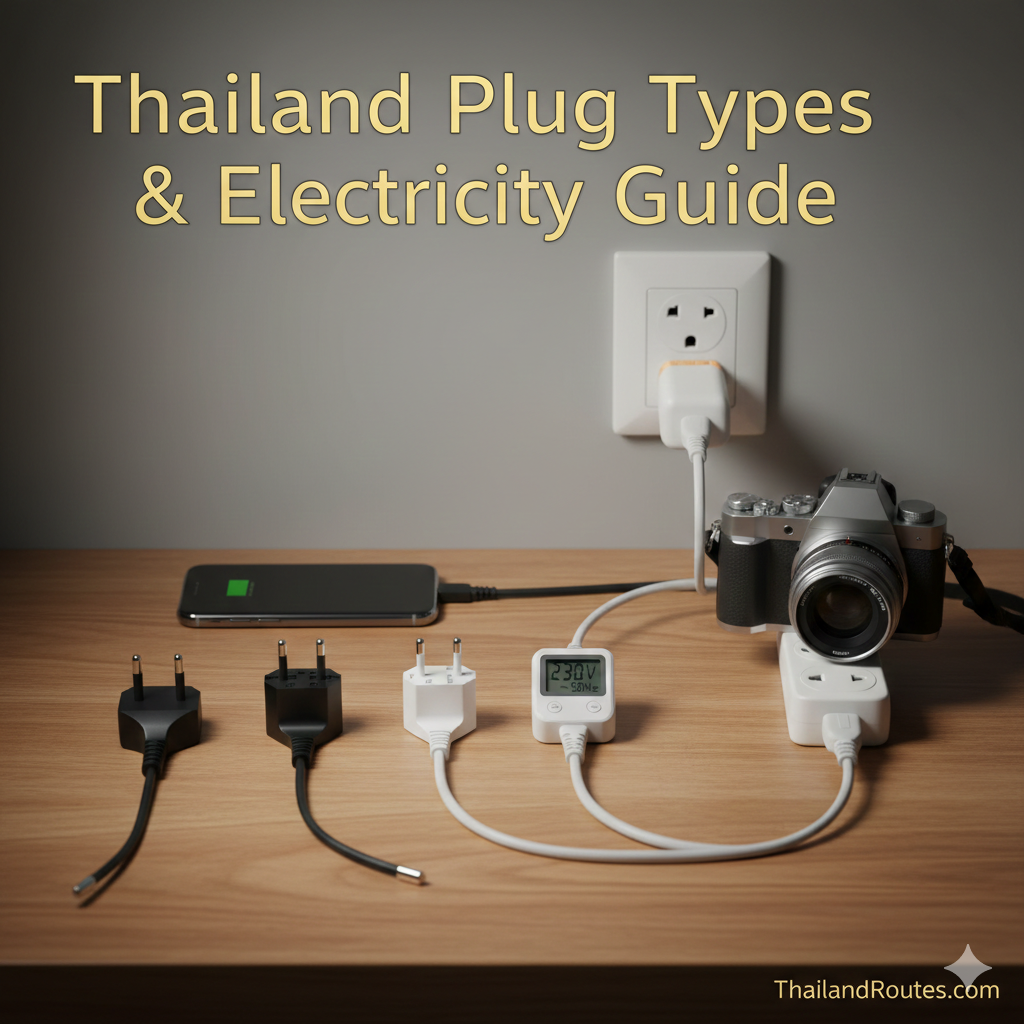
Thailand primarily uses three plug types: Type A, Type B, and Type C.
- Type A: Two flat parallel pins (used in the U.S. and Japan)
- Type B: Two flat parallel pins and a grounding pin
- Type C: Two round pins (common in Europe and Asia)
What This Means for Travelers
Thailand’s outlets are multi-socket designs, meaning they usually accept Type A, Type B, and Type C plugs. This is convenient because most travelers from North America, Europe, and Asia can plug their devices directly into the wall without major problems.
However, if your plug type is different—like Type G (used in the U.K.) or Type I (used in Australia)—you’ll need an adapter.
2. Voltage and Frequency in Thailand
- Voltage: 220 V
- Frequency: 50 Hz
This is the standard in most of Asia, Europe, and Australia. However, it differs from countries like the United States, which use 110–120 V and 60 Hz.
Many modern electronic devices (such as phones, laptops, cameras, tablets) are dual voltage, meaning they can handle both 110 V and 220 V automatically. But older or more sensitive electronics may require a voltage converter.
3. Plug Type Compatibility by Country
| Country | Plug Type(s) | Voltage | Adapter Needed? | Converter Needed? |
|---|---|---|---|---|
| USA | A, B | 120 V | No (for plug), Yes (for converter if device not dual voltage) | Maybe (check device) |
| Canada | A, B | 120 V | No adapter, converter may be required | Maybe |
| UK | G | 230 V | Yes adapter required | No (same voltage range) |
| Australia/New Zealand | I | 230 V | Yes adapter required | No |
| EU countries | C, E, F | 220–230 V | No adapter needed | No |
| Japan | A, B | 100 V | No adapter needed | Converter recommended for some devices |
| Singapore / Malaysia | G, M | 230 V | Yes adapter required | No |
| India | C, D, M | 230 V | Sometimes adapter required | No |
Tip: Check your device’s label. If it says “Input: 100–240V, 50/60Hz”, it can be used in Thailand without a converter.
4. Common Plug Types in Hotels and Airports
Thailand’s major cities and tourist destinations are well prepared for international visitors.
- Hotels: Most hotels, hostels, and resorts have universal sockets that accept multiple plug types. Higher-end hotels may even provide USB charging ports.
- Airports: Major airports like Suvarnabhumi Airport and Don Mueang International Airport offer charging stations with multiple plug compatibility.
- Cafes and coworking spaces: Popular with digital nomads, especially in Chiang Mai and Phuket, usually support both Type A and Type C.
However, rural areas may have older outlets that only fit Type C or Type A, so carrying a compact adapter is a smart idea.
5. Should You Bring an Adapter, Converter, or Both?
Many travelers confuse adapters with converters, but they serve different purposes.
- Adapter: Changes the shape of your plug so it fits the Thai outlet.
- Converter: Changes the voltage from your country’s standard to Thailand’s 220 V.
When You Only Need an Adapter
If your device is dual voltage (100–240 V), you only need a plug adapter. This applies to:
- Smartphones
- Laptops
- Tablets
- Cameras
- Power banks
When You Need a Converter
If your device is not dual voltage—like some hair dryers, curling irons, or electric shavers from the U.S.—you’ll need a voltage converter to avoid damaging it.
6. Recommended Travel Adapters for Thailand
In 2026, most travelers use universal travel adapters that work in multiple countries. When choosing one, look for:
- Support for Type A, B, and C plugs
- Surge protection to protect electronics from power spikes
- Built-in USB and USB-C ports
- Compact design for easy packing
Adapters with multiple ports allow you to charge your phone, camera, and laptop at the same time—a huge convenience when outlets are limited.
7. Electricity Safety in Thailand
Thailand’s electrical grid is generally reliable, but power fluctuations can happen, especially in rural areas or on islands.
Tips to stay safe:
- Use surge protectors or adapters with built-in protection.
- Avoid overloading sockets with too many devices.
- Unplug electronics during heavy thunderstorms.
- Keep devices and adapters away from water (especially in beach destinations).
Most hotels have modern wiring, but guesthouses or hostels in older buildings may have fewer outlets.
8. Power Outages and What to Expect
Power outages in Thailand are uncommon in big cities like Bangkok or Chiang Mai, but they can happen occasionally in smaller towns or islands like Koh Tao or Koh Phangan—usually short and harmless.
Pro tips:
- Carry a fully charged power bank.
- Save your work frequently if you’re using a laptop.
- Charge devices during the day when electricity is stable.
- Bring a small flashlight or use your phone torch during nighttime outages.
9. Charging Multiple Devices in Thailand
Many travelers bring several gadgets—phones, laptops, cameras, power banks, drones. But hotel rooms often have limited outlets.
Ways to manage this efficiently:
- Bring a multi-port USB charger or power strip with a built-in adapter.
- Avoid daisy-chaining multiple cheap adapters (it can be unsafe).
- Label your cables for easy packing.
- Charge devices overnight when demand is lower.
If you’re working remotely, investing in a high-quality travel adapter with fast charging capabilities is worth it.
10. Using USB-C and Fast Charging in Thailand
By 2026, USB-C has become the global charging standard for many electronics. In Thailand:
- Many newer hotels and cafes offer USB-C ports directly in wall outlets or lamps.
- If your device supports fast charging, bring your own charger to guarantee full speed.
- Keep a universal USB-C cable that works with multiple devices to reduce clutter.
Adapters with USB-C output are ideal for travelers who rely heavily on phones and laptops.
11. Plug Type Differences Between Regions in Thailand
While plug types are generally consistent across the country, there can be small differences:
- Big cities (Bangkok, Chiang Mai, Phuket): Modern sockets, multi-type compatible.
- Tourist islands (Koh Samui, Koh Phi Phi): Mostly modern sockets, though some older bungalows may require a Type C adapter.
- Rural areas: Occasionally limited socket types, often just Type C or old two-prong plugs.
Bringing one universal adapter ensures you’re covered everywhere.
12. Buying Adapters and Converters in Thailand
Forgot your adapter at home? No problem—Thailand sells them almost everywhere.
- Airports: More expensive but convenient.
- 7-Eleven stores: Affordable basic adapters for Type A/C plugs.
- Electronics shops or malls: Universal adapters and converters at good prices.
- Markets: Cheaper options, but make sure they’re good quality.
Pro tip: Spend a bit more on adapters with surge protection to safeguard expensive devices.
13. Surge Protection and Power Quality
Thailand’s electrical grid is fairly stable, but voltage fluctuations can happen.
Why this matters:
- Sensitive electronics like laptops and cameras can be damaged by sudden surges.
- Surge-protected adapters or power strips prevent accidents.
Look for travel adapters with:
- Built-in surge protection
- Overheating protection
- Grounding compatibility
14. Using High-Power Devices in Thailand
Devices like hair dryers, straighteners, kettles, and electric razors may not be dual voltage.
- Check your device label before plugging it in.
- If it only supports 110 V, use a voltage converter.
- Alternatively, buy or rent a local appliance in Thailand (many hotels provide hair dryers and kettles).
High-wattage devices can trip breakers or get damaged if used incorrectly.
15. Travel Adapter Etiquette in Shared Spaces
If you’re staying in a hostel or shared accommodation, outlets may be limited. To avoid conflicts:
- Charge overnight or during the day when others are out.
- Use a multi-port charger to share a single outlet.
- Don’t leave your devices plugged in unattended for long periods.
Respecting shared spaces makes everyone’s travel experience smoother.
16. Charging Drones, Cameras, and Power Banks
Many travelers bring cameras, drones, or other gadgets to capture Thailand’s stunning scenery.
Tips for these devices:
- Bring extra batteries for cameras and drones.
- Charge at night to avoid peak hour voltage dips.
- Use original chargers when possible—cheap alternatives can overheat.
- Carry a portable power bank during day trips.
Some national parks have limited power access, so being prepared is key.
17. Adapter and Converter Packing Checklist
When packing for Thailand, consider including:
- 1 universal travel adapter (Type A/B/C compatible)
- 1 USB-C charger with multiple ports
- Surge protector (built-in or separate)
- Voltage converter (if needed for specific devices)
- 1 power bank for emergencies
- Extra charging cables
This minimalist kit ensures all your devices stay powered, wherever your journey takes you.
18. Charging Tips for Digital Nomads and Long-Term Travelers
For digital nomads or anyone planning a long stay in Thailand:
- Invest in a high-quality universal adapter with multiple ports.
- Use a small travel extension cord for coworking spaces.
- Choose accommodations with reliable power and Wi-Fi.
- Consider a backup battery pack for your laptop.
Cities like Chiang Mai and Bangkok have excellent infrastructure, but remote areas may require more preparation.
19. Common Mistakes to Avoid
- Bringing only a converter or only an adapter (you may need both).
- Forgetting to check voltage compatibility.
- Buying cheap, low-quality adapters that can overheat.
- Relying on a single charging cable.
- Assuming every hotel will provide universal sockets.
A few minutes of preparation before your trip can save you headaches later.
20. Final Thoughts: Plug In and Power Up Confidently in Thailand
In 2026, Thailand uses plug types A, B, and C, with a standard voltage of 220 V at 50 Hz. Most modern devices work seamlessly with a simple adapter, making it easy for travelers from around the world to stay connected.
The best approach is to bring a universal travel adapter with surge protection, especially if you carry multiple devices. Check your electronics to see if they’re dual voltage, and bring a converter only if necessary.
Whether you’re a backpacker, vacationer, or digital nomad, keeping your devices charged ensures a smoother and more connected travel experience. From Bangkok’s neon nights to the quiet beaches of Koh Samui, understanding plug types in Thailand means you’ll never be stuck with a dead battery when you need your phone the most.
Stay powered, stay smart, and enjoy your time in Thailand.
Thailand Plug Types & Electricity Guide 2026: Power Adapter Tips for Travelers
Leave a Reply