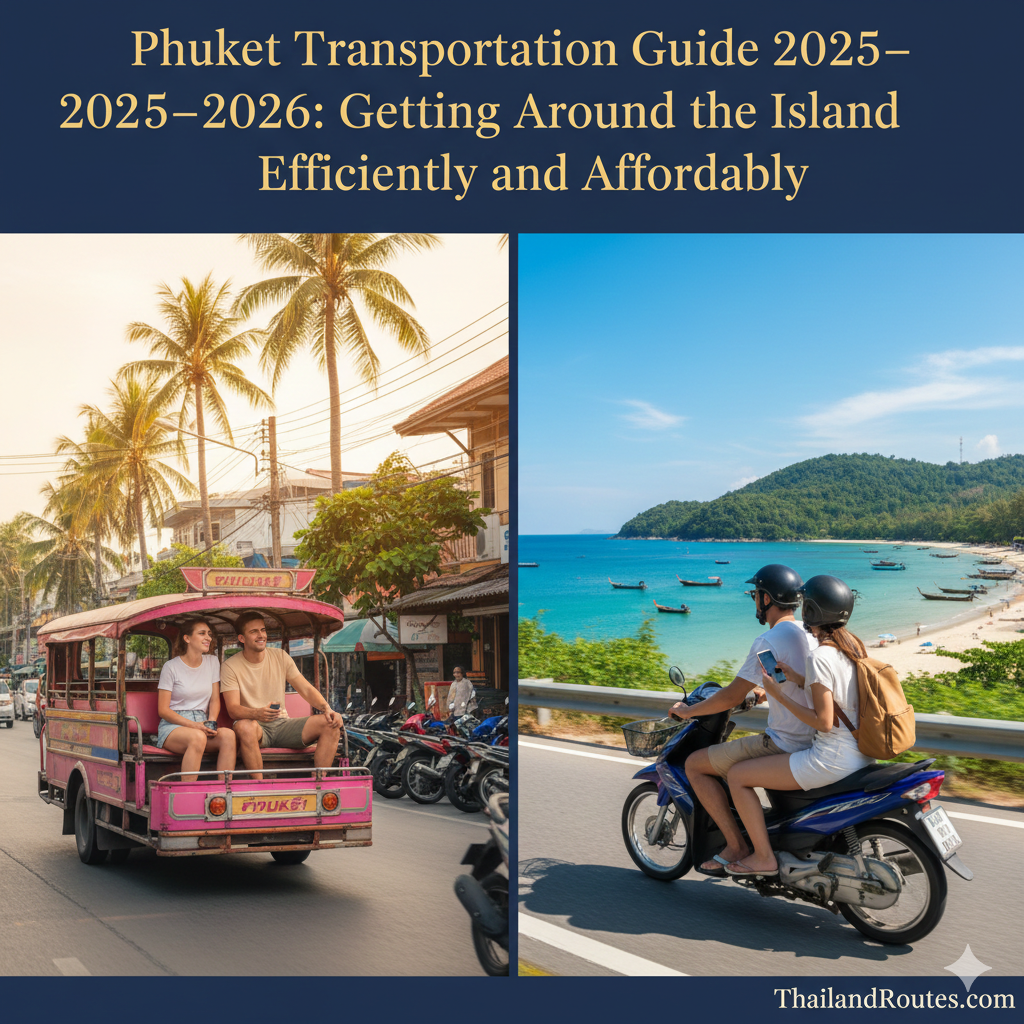
Introduction: Navigating the Island of Contrasts
Phuket, Thailand’s largest island, combines postcard-perfect beaches with winding jungle roads and lively city streets.
But for many first-time visitors, getting around Phuket can be confusing. Public transportation is limited, taxi fares vary, and traffic behaves with its own rhythm.
This 2025–2026 Phuket transportation guide will help you navigate the island with confidence — whether you’re a backpacker on a scooter, an expat commuting daily, or a couple heading to the airport.
You’ll find detailed information on every mode of transport, cost breakdowns, safety advice, and insider tips to save money while exploring Phuket.
1. Overview: How to Get Around Phuket
Phuket offers multiple ways to travel, each fitting a different lifestyle or budget.
From budget-friendly songthaews (local buses) to private transfers, taxis, and scooter rentals, there’s something for every traveler.
| Mode of Transport | Ideal For | Average Cost Range (THB) |
|---|---|---|
| Motorbike rental | Solo travelers, expats | 2500–4000/month |
| Taxi / Grab / Bolt | Families, short trips | 150–600/trip |
| Airport transfer | Arrivals & departures | 300–1000 |
| Songthaew (local bus) | Budget travel | 40–60/ride |
| Smart Bus | Beach-to-beach connection | 100–170/ride |
| Car rental | Families, groups | 1200–2500/day |
| Ferries / Speedboats | Island hopping | 500–1500/route |
Phuket is roughly 50 km long and 20 km wide — distances can look short on the map but take time due to hills and traffic.
2. From Phuket International Airport (HKT)
Airport Location
Phuket International Airport (HKT) lies in the north of the island, about 35 km from Patong and 40 km from Phuket Town.
Airport to Main Areas (Travel Time & Cost)
| Destination | Distance | Approx. Time | Taxi / Grab | Smart Bus | Minivan Shuttle |
|---|---|---|---|---|---|
| Patong Beach | 40 km | 60–75 min | 700–900 THB | 170 THB | 180 THB |
| Phuket Town | 32 km | 45–60 min | 600–800 THB | 150 THB | 160 THB |
| Kata / Karon | 47 km | 70–90 min | 800–1000 THB | 170 THB | 200 THB |
| Bang Tao / Laguna | 20 km | 30–40 min | 500–700 THB | 100 THB | 150 THB |
| Rawai / Nai Harn | 50 km | 80–100 min | 900–1200 THB | – | 250 THB |
Airport Transport Options
1. Airport Smart Bus
- Runs from Phuket Airport → Rawai (stops at major beaches: Nai Thon, Surin, Kamala, Patong, Karon, Kata).
- Operating hours: 6:00 a.m. – 9:00 p.m.
- Fare: 100–170 THB (depends on distance).
- Best budget choice for solo travelers.
2. Airport Minivan
- Shared vans available at the arrivals exit.
- Cost: 150–200 THB per person.
- Drops passengers directly at hotels but can take longer due to multiple stops.
3. Airport Taxi
- Official taxi counter available (follow yellow signs).
- Fares are fixed and include 100 THB airport surcharge.
- Safer than random touts waiting outside.
4. Grab / Bolt
- Ride-hailing apps available but sometimes restricted within airport zone.
- Best to walk 100m outside the terminal for pickup.
3. Grab and Bolt in Phuket (2025–2026 Update)
Ride-hailing apps like Grab and Bolt have revolutionized Phuket’s transport.
Both apps operate throughout the island, with Bolt generally cheaper but Grab offering better coverage.
| App | Availability | Price Level | Payment Options |
|---|---|---|---|
| Grab | Island-wide | Medium | Credit card / cash |
| Bolt | Main areas | 10–20% cheaper | Cash only (mostly) |
Typical short ride (Patong to Karon): 150–200 THB
Longer trips (Patong to Phuket Town): 300–400 THB
Tips:
- Use GrabTaxi option if normal GrabCar unavailable.
- Always check driver ratings.
- During rain or rush hour, prices can surge up to 1.5x.
SEO tip: The query “Grab in Phuket” is one of the top travel search terms in 2025 — this section targets that keyword naturally.
4. Taxis in Phuket
Taxis are plentiful but often expensive compared to the rest of Thailand.
Most are red or yellow cars, metered in theory but often prefer fixed fares.
Average Taxi Prices
| Route | Approx. Fare (THB) |
|---|---|
| Patong ↔ Karon | 200–300 |
| Patong ↔ Kata | 250–350 |
| Patong ↔ Phuket Town | 400–600 |
| Patong ↔ Airport | 800–900 |
| Kata ↔ Airport | 1000–1100 |
Taxi Tips
- Ask “meter please”, but be prepared for negotiation.
- If possible, pre-book through hotel or app.
- Some beaches (like Kamala and Rawai) have taxi stands with set price boards.
- Taxis are safe, but always confirm the price before getting in.
5. Motorbike Rentals — The Most Popular Choice
For freedom and flexibility, nothing beats renting a motorbike in Phuket.
It’s the preferred option for long-term residents and adventurous travelers.
Rental Costs (2025 Averages)
| Type of Bike | Daily Rate | Monthly Rate |
|---|---|---|
| Automatic 110–125cc (Honda Click, Scoopy) | 250–300 THB | 2500–3500 THB |
| 150cc (Yamaha NMax, PCX) | 350–450 THB | 4000–5000 THB |
| Big bike (250cc+) | 600–1000 THB | 8000–12000 THB |
Requirements
- Valid driver’s license (international preferred).
- Passport copy and deposit (2,000–5,000 THB).
- Always check tires, brakes, and lights before riding.
Fuel Cost
Gasoline: 36–40 THB per liter.
Full tank lasts 3–4 days for average use.
Safety Tips
- Always wear a helmet (mandatory by law).
- Drive defensively — traffic can be unpredictable.
- Avoid riding during heavy rain or on steep hills near Patong–Karon.
Motorbikes are cheap, efficient, and scenic, but require caution and common sense.
6. Car Rentals in Phuket
Ideal for families or groups, renting a car offers comfort and safety — especially for long-distance trips or during rainy season.
Prices
- Economy car (Toyota Yaris, Vios): 1200–1600 THB/day
- SUV (Honda CR-V, Fortuner): 1800–2500 THB/day
- Weekly / Monthly rentals: 15,000–25,000 THB/month
Rental Conditions
- International Driver’s Permit required.
- Deposit: 10,000–20,000 THB.
- Insurance coverage varies; always confirm it’s full insurance (first class).
- Fuel policy: usually full-to-full.
Tip: Driving is on the left side in Thailand.
Parking is free in most areas but avoid red-yellow painted curbs (no-parking zones).
7. Songthaews – The Local Blue Buses
Songthaews are iconic blue open-air trucks that act as Phuket’s local bus service.
They connect Phuket Town to beaches, operating from morning till early evening.
Routes and Fares
| Route | Fare (THB) | Operating Hours |
|---|---|---|
| Phuket Town – Patong | 40–50 | 6:00 a.m.–6:00 p.m. |
| Phuket Town – Kata / Karon | 50–60 | 6:00 a.m.–6:00 p.m. |
| Phuket Town – Kamala | 50–60 | 6:30 a.m.–5:30 p.m. |
| Phuket Town – Surin / Bang Tao | 60–70 | 6:30 a.m.–5:30 p.m. |
They don’t connect beaches to each other directly — you must go via Phuket Town.
Songthaews are slow but scenic, perfect for budget travelers and photographers.
Note: No fixed stops — just wave your hand to get on or press the buzzer to get off.
8. Phuket Smart Bus — Connecting the West Coast
Introduced to modernize transport, the Phuket Smart Bus is an air-conditioned alternative connecting the airport and southern beaches.
Route
Airport → Nai Thon → Surin → Kamala → Patong → Karon → Kata → Rawai
Cost
100–170 THB (depending on distance).
Payment via Rabbit Card or cash on board.
Schedule
Every 60–90 minutes between 6:00 a.m. and 9:00 p.m.
It’s clean, safe, and reliable — perfect for solo travelers or digital nomads staying long-term.
9. Tuk-Tuks and Local Shuttles
Phuket’s tuk-tuks are larger red or yellow mini-vans, not the small three-wheelers you see in Bangkok.
They are fun for short beach transfers but relatively pricey.
Prices
- Short rides: 100–200 THB
- Longer routes: 300–500 THB
Always negotiate before boarding — there are no meters.
Tip: For groups, tuk-tuks can still be cheaper than taxis if the fare is shared.
10. Buses to Other Cities
If you plan to travel outside Phuket, long-distance buses are available.
| Destination | Travel Time | Cost (THB) | Type |
|---|---|---|---|
| Bangkok | 12–14 hrs | 700–1000 | VIP / Sleeper bus |
| Krabi | 3–4 hrs | 200–300 | Minivan / Bus |
| Phang Nga | 2 hrs | 150–250 | Local bus |
| Surat Thani (ferry to Koh Samui) | 5–6 hrs | 300–400 | Bus + ferry combo |
The Phuket Bus Terminal 2 (north of Phuket Town) is the main hub for all intercity routes.
11. Ferries and Island Hopping
Phuket is the gateway to the Andaman Sea’s most stunning islands.
Daily ferries and speedboats connect the island to Phi Phi, Krabi, Koh Lanta, Racha, and Similan Islands.
Ferry Ports
- Rassada Pier (Phuket Town) – Main terminal for Phi Phi and Krabi.
- Chalong Pier – For island tours and diving trips.
- Ao Po Grand Marina – For luxury yachts and Koh Yao transfers.
Average Prices (One-Way)
| Route | Ferry | Speedboat |
|---|---|---|
| Phuket – Phi Phi | 400–600 THB | 900–1200 THB |
| Phuket – Krabi | 500–700 THB | 1000–1300 THB |
| Phuket – Koh Yao Noi / Yai | 200–300 THB | 400–600 THB |
Ferry travel is scenic but weather-dependent — check conditions during monsoon months (May–October).
12. Bicycles and Walking
Phuket is not ideal for long-distance walking due to narrow roads and hills, but short strolls within beach towns are pleasant.
Bicycle rentals exist in Kata, Karon, and Nai Harn for 200–300 THB/day, suitable for exploring back roads.
For fitness enthusiasts, morning rides along Bang Tao and Laguna are safe and beautiful.
13. Transportation Apps and Useful Tools
| App | Function |
|---|---|
| Grab / Bolt | Ride-hailing |
| 12Go Asia | Ferry & bus booking |
| Phuket Smart Bus | Real-time bus tracking |
| Google Maps | Navigation (works offline if downloaded) |
| Wise / Revolut | Payment apps for travelers |
Having these apps installed before arrival makes transportation far smoother.
14. Traffic and Driving Conditions
Phuket’s traffic is lively but manageable once you adapt.
Rush hours: 8–9 a.m. and 5–7 p.m., especially around Patong Hill and Chalong Circle.
Driving Tips
- Drive slowly and defensively; locals often overtake unexpectedly.
- Rainy season roads become slippery — avoid sudden turns.
- Always carry a copy of your license and passport.
- Police checkpoints are common; helmets and licenses are mandatory.
15. Future of Transportation in Phuket (2026 Outlook)
The local government and Thailand’s Transport Authority are investing in new mobility infrastructure, including:
- Expansion of Smart Bus routes to east Phuket and airport suburbs.
- Introduction of electric tuk-tuks and bike-sharing systems.
- Long-term plan for Phuket Light Rail (Tram Project) connecting Airport → Chalong Pier (projected 2027).
- Improved road safety and signage for tourists.
These developments aim to make Phuket more eco-friendly and accessible in the coming years.
16. Common Tourist Mistakes (and How to Avoid Them)
- Taking random taxis without checking price → Always confirm before boarding.
- Riding without a helmet → Fines are common (500 THB minimum).
- Driving without a license → Not covered by insurance in case of accident.
- Underestimating distances → Phuket looks small but travel time can be long.
- Ignoring fuel levels → Some areas have few gas stations late at night.
- Leaving valuables in tuk-tuks → Keep your phone and wallet on hand.
Staying aware and respectful goes a long way in ensuring safe travels.
17. Sample Daily Transport Costs (2025–2026)
| Traveler Type | Daily Cost | Transportation Mode |
|---|---|---|
| Budget traveler | 100–200 THB | Songthaew, walking |
| Mid-range | 300–600 THB | Grab / motorbike |
| Luxury | 1000+ THB | Private car, taxis |
Even with occasional taxis, total monthly transportation rarely exceeds 4,000–6,000 THB for most residents.
18. Suggested Travel Routes Around Phuket
1. Beach-Hopping Route (West Coast)
Patong → Karon → Kata → Nai Harn → Rawai
Ideal by scooter or Smart Bus.
2. Cultural Route (Phuket Town)
Old Town → Wat Chalong → Big Buddha → Central Festival Mall
Best with Grab or rented car.
3. Northern Escape
Bang Tao → Nai Thon → Mai Khao Beach → Sarasin Bridge
Perfect for a quiet day trip by motorbike or car.
Conclusion: Freedom Awaits on Phuket’s Roads and Waves
Getting around Phuket can seem complex at first, but with the right tools and a little local knowledge, it becomes part of the island’s charm.
From riding a scooter past palm trees to hopping a ferry toward turquoise islands, transportation here isn’t just practical — it’s an experience.
In 2025–2026, Phuket continues to evolve: safer roads, greener vehicles, and digital tools make island travel easier than ever.
Whether you’re staying a week or a year, you’ll find a rhythm that suits your pace — from the hum of a scooter to the slow glide of a ferry.
Phuket isn’t just a destination. It’s a journey — and knowing how to move through it turns travel into pure freedom.
Leave a Reply