The Beating Heart of Local Transport in Chiang Mai
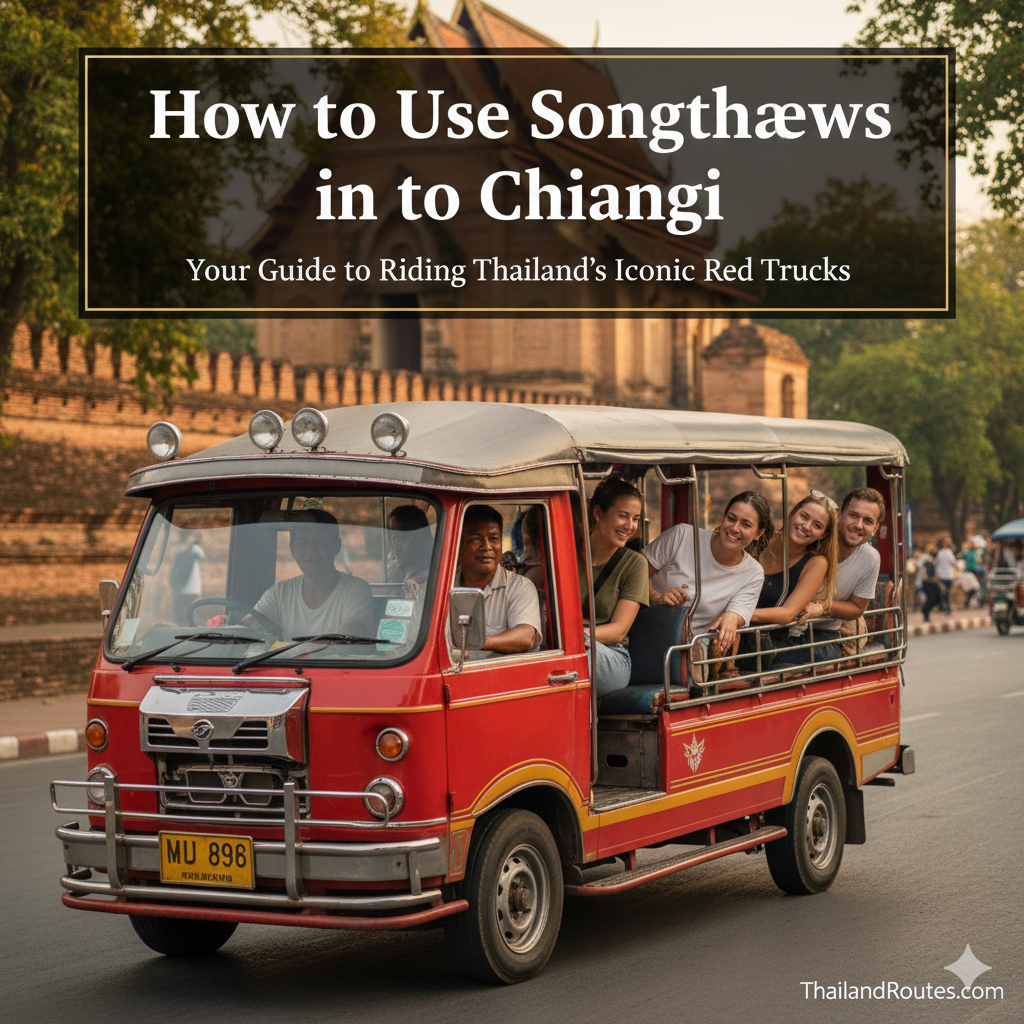
Chiang Mai is a city that blends tradition, modernity, and a surprisingly efficient local transport system. Unlike Bangkok, which relies on skytrains and metro lines, Chiang Mai’s most iconic and practical way to get around isn’t a train, bus, or taxi. It’s a bright red truck called a Songthaew (pronounced song-tao).
These red trucks are everywhere. They’re cheap, flexible, and woven into the daily rhythm of the city. Whether you’re heading to the Old City, Nimmanhaemin Road, or a temple on the outskirts, a songthaew can get you there. But to use them effectively, it helps to know how the system works — because there are no official stops, routes are flexible, and fares aren’t written down anywhere.
This guide will teach you everything you need to know about using songthaews in Chiang Mai like a pro.
1. What is a Songthaew?
The word “Songthaew” literally means “two rows” in Thai. These vehicles are modified pickup trucks with two parallel benches in the back for passengers. A roof covers the seating area, and the back is open for easy hop-on and hop-off access.
The most common type in Chiang Mai is bright red — hence the nickname “red truck”. But you may also see other colors, each serving slightly different routes or purposes.
- Red Songthaews: The most common, operating like shared taxis around the city.
- Yellow Songthaews: Travel between Chiang Mai and rural areas.
- Blue Songthaews: Usually used for trips to nearby towns.
- White Songthaews: Often connect the airport or long-distance routes.
For most visitors, the red songthaew is the essential one to know.
2. Why Songthaews Are the Best Way to Travel in Chiang Mai
There are plenty of ways to get around Chiang Mai — tuk-tuks, Grab (ride-hailing), scooters, bicycles. But red songthaews offer a unique combination of benefits:
- Budget-friendly: Rides inside the Old City usually cost around 20–30 THB per person (less than $1 USD).
- No strict routes: They work on a semi-flexible system. You can hop on one going in your direction.
- Easy to find: There are hundreds driving around the city day and night.
- Local experience: You’ll be sharing the ride with locals, monks, students, and travelers.
- Eco-friendly: One vehicle serves multiple passengers, reducing congestion.
3. How to Identify and Flag Down a Songthaew
Unlike a bus, songthaews don’t have fixed stops. You flag them down like a taxi. Here’s how to do it right:
- Stand on the side of the road facing the direction you want to travel.
- Raise your hand with your palm facing down as a songthaew approaches.
- If the driver slows down or pulls over, tell them your destination.
- If they’re going that way, they’ll nod or quote a price. If not, they’ll simply drive off.
Don’t take it personally — songthaews work on efficiency. If your stop is out of their current route, they might skip you to pick up passengers heading in the same direction.
4. Understanding How Songthaews Work
This is where songthaews differ from taxis or buses. They operate on a shared, semi-fixed route system:
- Drivers typically follow a loose loop through major roads and districts.
- If your destination is along or near their path, they’ll take you.
- They might make several stops to pick up or drop off other passengers.
- You usually don’t get the truck to yourself, unless you negotiate a private ride.
Think of it as a mix between a taxi and a minibus — flexible but shared.
5. Negotiating the Fare (and When You Don’t Have To)
One of the biggest worries for first-time travelers is the price. The good news is that short trips inside the Old City or nearby areas have standard fares:
- Inside Old City: 20–30 THB per person.
- Old City to Nimmanhaemin: 30–40 THB per person.
- Airport to Old City: 50–60 THB per person.
- Longer or private trips: Negotiable, usually 100+ THB depending on distance.
Tips for handling fares:
- Always confirm the price before getting in.
- Say your destination clearly (e.g., “Tha Phae Gate,” “Nimman,” “Airport”).
- If they quote a high price for a short trip, politely say no and wait for another truck. There are always more coming.
- Pay when you get off, not before.
6. How to Pay
Payment is simple and cash-based.
- When you arrive at your stop, press the “stop” button (or bang gently on the metal bar to signal the driver).
- Get out through the back.
- Walk to the driver’s window and hand over the exact amount in cash.
Most drivers don’t carry change for large bills, so it’s smart to carry small notes (20, 50, 100 THB).
7. Common Routes and Destinations for Red Songthaews
Although songthaews don’t have fixed routes like buses, most drivers circulate along popular travel paths. Here are a few common ones:
- Old City ↔ Nimmanhaemin: Perfect for cafe hopping, digital nomads, and nightlife.
- Old City ↔ Chiang Mai Airport: A fast and cheap airport transfer.
- Old City ↔ Wat Phra Singh & Wat Chedi Luang: Easy access to famous temples.
- Old City ↔ Warorot Market: For local shopping and food.
- Old City ↔ Maya Mall: A popular modern mall near Nimman.
- Old City ↔ Chiang Mai University: Common route for students.
Longer trips, like to Doi Suthep Temple, are also possible but usually require a private hire.
8. Private vs. Shared Songthaew Rides
Shared Ride (Regular Use)
- Cheapest option (20–40 THB per person).
- You share with strangers.
- The driver makes multiple stops.
- Perfect for short, central trips.
Private Ride
- You can hire the entire truck if you have a group or need to go off the common routes.
- Price depends on distance and time.
- Example: Old City to Doi Suthep Temple — around 200–400 THB one way.
- Good for day trips or temple hopping.
- Negotiation is expected; don’t be afraid to counter politely.
9. Best Times to Use Songthaews
- Morning (7:00–10:00 AM): Excellent availability. Locals commute to work or school.
- Afternoon (10:00 AM–4:00 PM): Still easy to find; lighter traffic.
- Evening (4:00 PM–9:00 PM): Popular for tourists and nightlife trips.
- Late night: Some trucks operate near bars and night markets, but not all. For late rides, a tuk-tuk or Grab may be more reliable.
10. Songthaews vs. Other Transport in Chiang Mai
| Transport Type | Price Range (THB) | Best For | Pros | Cons |
|---|---|---|---|---|
| Songthaew (Red Truck) | 20–40 shared / 100+ private | Budget travelers, flexible routes | Cheap, local vibe, everywhere | No fixed schedule, sometimes crowded |
| Tuk-Tuk | 80–200+ (negotiated) | Short, private rides | Fast, fun | Can be overpriced for tourists |
| Grab / Taxi | 100–300+ | Comfortable, direct routes | A/C, no bargaining | More expensive |
| Scooter rental | 150–300 per day | Independent travelers | Full freedom | Requires driving confidence & license |
| Bicycle / Walking | Free – 50 per day | Old City exploration | Eco-friendly, intimate experience | Limited range |
Songthaews strike a sweet balance between cost, flexibility, and local authenticity.
11. Do’s and Don’ts When Using Songthaews
Do:
- Wave politely to flag them down.
- Speak slowly and clearly when saying your destination.
- Carry small cash for easy payment.
- Be patient — they might make multiple stops.
- Smile — it goes a long way in Thailand.
Don’t:
- Don’t expect exact bus-like routes or timetables.
- Don’t pay before arriving unless it’s a private ride.
- Don’t argue loudly over prices. If you don’t like the fare, just wait for another truck.
- Don’t block the back entrance when others need to get in or out.
12. Safety Tips for Songthaew Passengers
- Sit facing inward and hold onto the metal rail while the truck moves.
- Avoid standing or leaning out the back.
- Keep your belongings close — Chiang Mai is safe, but caution is smart.
- In rainy season, bring a light rain jacket. The back is open, and sometimes rain can blow in.
- Don’t jump out before the truck fully stops.
13. Using Songthaews for Tourist Attractions
Many popular tourist spots around Chiang Mai are accessible by songthaew. Here’s a quick guide to a few:
Doi Suthep Temple
- You can share a red truck from the North Gate of the Old City.
- Standard price: around 60 THB per person if the truck is full.
- Private hire: 200–400 THB.
- The road is winding uphill — hold tight during the ride!
Chiang Mai Night Bazaar
- Red trucks constantly circle this area.
- Standard price: 20–30 THB from the Old City.
Warorot Market
- One of the oldest local markets.
- A short ride from Tha Phae Gate or Nimman.
Central Festival Mall or Maya Mall
- Red trucks regularly serve these malls for locals and students.
- Usually around 30 THB.
14. Common Phrases and Thai Words That Help
Using a few Thai words can make your interaction smoother:
- “Pai…” (ไป) = “Go to…”
Example: “Pai Tha Phae Gate.” - “Tao rai?” (เท่าไหร่) = “How much?”
- “Khop khun krub/ka” (ขอบคุณครับ/ค่ะ) = “Thank you.”
(krub = male speakers, ka = female speakers) - “Mai ao” (ไม่เอา) = “No, thank you.”
Even basic Thai phrases show respect and can help you get fairer prices.
15. When Not to Use Songthaews
Songthaews are excellent most of the time, but they’re not perfect for every situation:
- If you’re in a hurry: Since they pick up other passengers, it might take longer than a direct taxi.
- If it’s late at night: Availability drops after 10 PM.
- If you have a lot of luggage: Not ideal because the seating area is limited.
- If you’re traveling far outside the city: Better to book a private taxi or organized transport.
16. Insider Tips for First-Time Riders
- Watch how locals do it. Chiang Mai residents use songthaews daily — mimic their casual approach.
- If you’re unsure about the fare, ask your hotel or hostel what a fair price should be before heading out.
- Avoid rushing. If the first driver quotes a high price, another will come in a minute.
- If you’re traveling in a group, it’s often cheaper to negotiate a private ride.
- Don’t stress about “missing” your stop — just ring the bell or knock, and the driver will let you off anywhere along the route.
17. A Day in Chiang Mai Using Only Songthaews (Sample Itinerary)
This simple itinerary shows how easily you can explore the city with just red trucks:
- Morning: Take a songthaew from your hotel in the Old City to Doi Suthep (60 THB shared).
- Midday: Ride back down and stop at Warorot Market for local snacks (20 THB).
- Afternoon: Hop on another songthaew to Nimmanhaemin for coffee and shopping (30 THB).
- Evening: End the day at the Night Bazaar and return to your hotel (20 THB).
Total cost: around 130 THB (~$3.50 USD) for a full day of exploring. That’s unbeatable value.
18. Songthaews and Sustainable Travel
Using songthaews isn’t just cheap — it’s also environmentally friendly. Instead of multiple tuk-tuks or private taxis on the road, one shared truck can carry up to 10 people.
This helps reduce emissions and supports local drivers. Many of these drivers are Chiang Mai residents who’ve been working in transport for decades. Your fare directly supports their livelihoods.
19. Final Thoughts: Travel Like a Local
There’s something charming about riding through Chiang Mai in the back of a red songthaew. The breeze on your face, the temple spires passing by, the mix of locals and travelers sharing the same ride — it’s a uniquely Thai experience.
Once you learn how the system works, using songthaews becomes second nature. You’ll save money, move efficiently, and connect more deeply with the city’s everyday rhythm.
So next time you’re standing on a Chiang Mai street, don’t hesitate. Raise your hand, smile, and hop on. You’re not just getting a ride — you’re joining a local tradition.
Leave a Reply